Saturday, 26 January 2013

Applications for Geneva Academy LLM

-->
The Geneva Academy of International Humanitarian Law and Human Rights has opened the applications for its 2013/2014 LL.M. Programme in International Humanitarian Law and Human Rights. Students follow advanced courses and seminars in all branches of international law applicable to situations of armed conflict. The Programme aims at preparing students for leadership roles in governments as well as international and non-governmental organizations.
The Master's core courses are taught in English and exams can be taken either in English or in French. Optional classes and activities are available in both languages. The resident faculty is comprised of professors from the Law Faculty and the Graduate Institute, and the visiting faculty consists of professors and lecturers principally from other universities, recognized for their expertise in one of the branches of international law covered in the Master's programme. In addition, experts and professionals participate by teaching short modules and delivering lectures. As part of the LL.M., students have the chance to pursue internships in Geneva-based NGOs and international organizations. The Master's degree is jointly issued by the University of Geneva and the Graduate Institute of International and Development Studies.
The Programme is open to candidates holding a degree in law and showing a strong interest in the application of international law in times of armed conflict. The application deadline is set for Friday 15 February 2013. More information on the programme is available at the website http://www.geneva-academy.ch/llm-master/overview/programme

The Three Charters

Yesterday I delivered the inaugural lecture (in Dutch, the oratie) of the chair in international criminal law and human rights at Leiden University. It was entitled 'The Three Charters', and it attempted to weave together the Charter of the United Nations, the Charter of the International Military Tribunal and the Universal Declaration of Human Rights. Here is the text of the lecture.
Signing the wall in the 'sweat room' (with Penelope)
The oratie is a magnificent tradition at one of the world's great universities. It takes place in a building that is many hundreds of years old. Those in attendance comprised my many new colleagues at Leiden, including two distinguished professors emeriti, Frits Kaltshoven and John Dugard, international judges from the International Criminal Court, the International Criminal Tribunal for the former Yugoslavia, the Special Court for Sierra Leone and the Special Tribunal for Lebanon, and a large number of past and present students.

Thursday, 24 January 2013


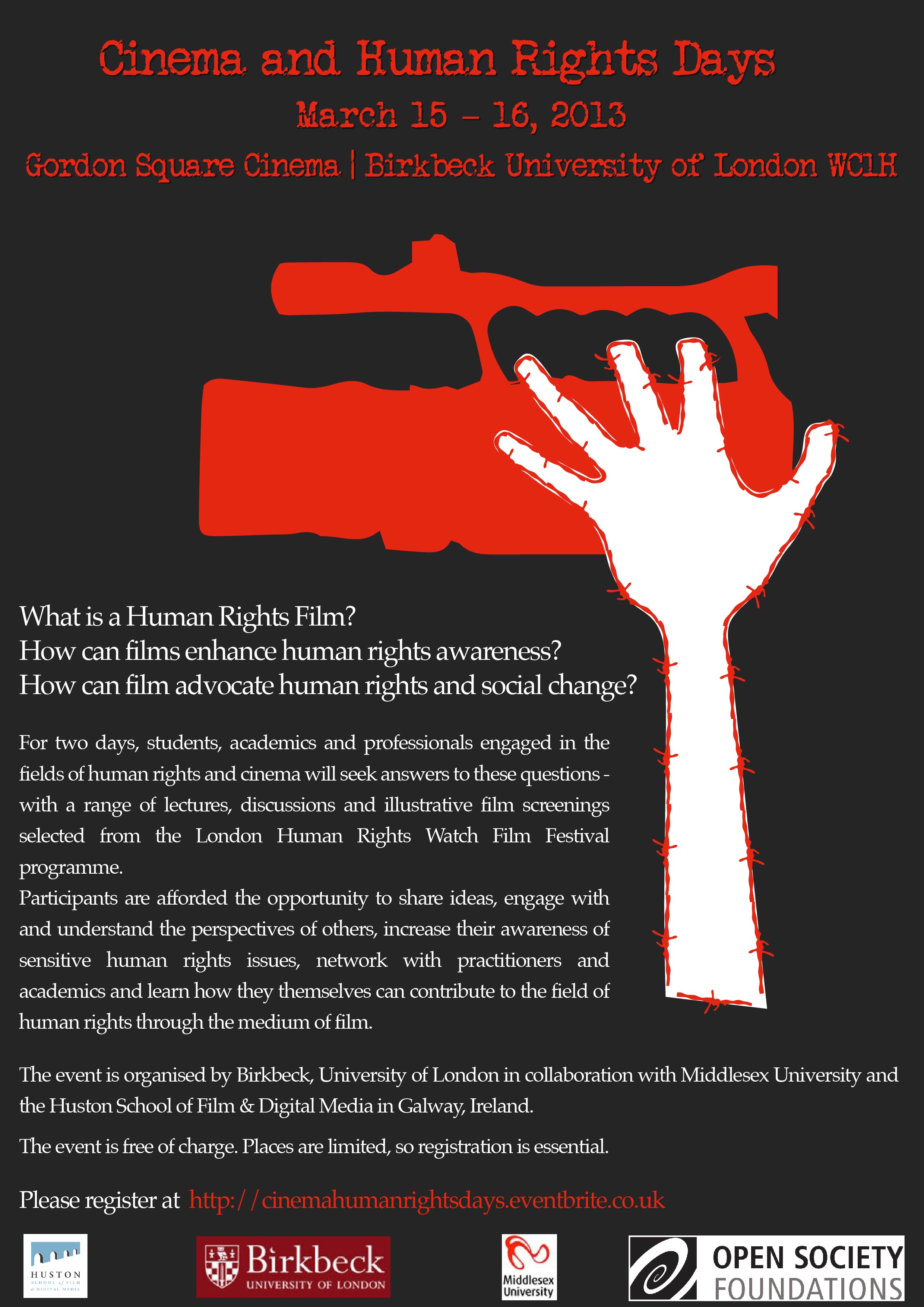
Cinema and Human Rights Days is a two day event taking place on March 15th and 16th, 2013 at Birkbeck, University of London and it offers an exciting programme of lectures, discussions,  screenings of extracts and film screenings selected from the London Human Rights Watch Film Festival.  
The event is addressed to students and young professionals of human rights in the film and media sector in London wishing to broaden their understanding on the connection between film, media and human rights, on what a human rights film is, and how human rights  films can  raise awareness  and ultimately be able to influence cultural, political and social  change. 
Participants are afforded the opportunity to share ideas, engage with and understand the perspectives of others, increase their awareness of sensitive human rights issues, network with practitioners and academics and learn how they themselves can contribute to the field of human rights through the medium of film.
Click here to download the programme of the event as well as speakers' biographies.
The event is free of charge. Places are limited, so registration is essential.


Friday, 11 January 2013

Ukraine Ordered to Reinstate Supreme Court Judge by European Court of Human Rights


The European Court of Human Rights has ruled in favour of Oleksandr Volkov, who was dismissed from his post as a Supreme Court judge of Ukraine in May 2010 due to an alleged ‘breach of oath’. The Court found violations of the right to a fair trial and respect for private life and ordered Ukraine to reinstate him immediately as a Supreme Court judge, the first time the Court has made such an order. Mr Volkov was represented by the European Human Rights Advocacy Centre (EHRAC) based at Middlesex University.  
Mr Volkov was appointed as a Supreme Court judge in 2003. In 2008, proceedings were brought against him before the High Council of Justice for alleged professional misconduct, and he was consequently dismissed by the plenary parliament from his post in 2010 for “breach of oath”. Mr Volkov appealed unsuccessfully to the Higher Administrative Court  against his dismissal.
In its judgment, the Court found four separate violations of the right to a fair hearing (Article 6(1)). Firstly, the bodies which considered Mr Volkov’s case were not independent and impartial. There were ‘structural deficiencies’ in the proceedings before the High Council of Justice, a number of whose members were also found to be personally biased. The hearing of the case by Parliament “only served to contribute to the politicisation of the procedure and to aggravate the inconsistency of the procedure with the principle of the separation of powers”. These defects were not considered to have been remedied during the review of the case by the Higher Administrative Court.
Secondly, the principle of legal certainty was breached because there was no limitation period relating to the proceedings against Mr Volkov.
Thirdly, the principle of legal certainty was also violated because, during the plenary meeting of Parliament, ‘the MPs present deliberately and unlawfully cast multiple votes belonging to their absent peers’, which violated the Ukrainian Constitution and other legislation. Fourthly, the chamber of the Higher Administrative Court was not considered to be a ‘tribunal established by law’ because its president had continued to perform the duties of president after the expiry of the relevant statutory time limit.
The Court also found a violation of Article 8 of the Convention because Mr Volkov’s dismissal from the post of judge did not comply with the domestic law and also because the law was arbitrary.
The Court ordered the Ukrainian authorities to reinstate Mr Volkov in the post of Supreme Court judge ‘at the earliest possible date’.
Significantly, the Court found ‘serious systemic problems as regards the functioning of the Ukrainian judiciary’ and ordered Ukraine to carry out reform of the system of judicial discipline, including legislative reform.
My colleague Prof. Philip Leach, who directs the  European Human Rights Advocacy Centre at Middlesex, commented: “We are delighted by this decision. Mr Volkov was the victim of endemic political corruption, which this judgment confirms is prevalent in Ukraine. It is significant that the European Court has, for the first time, ordered the reinstatement of someone who was unfairly dismissed. This judgment confirms that the Ukrainian legal system is in urgent need of fundamental reform.”  

Wednesday, 2 January 2013

America's Retreat from the Death Penalty

See the editorial in yesterday's International Herald Tribune and today's New York Times entitled America's Retreat from the Death Penalty.
Thanks to Bill Hartzog.

Saturday, 22 December 2012

Dr. Annabel Egan

From left, Jan Wouters, myself, Annabel and Ray Murphy.
Annabel Egan successfully defended her doctoral thesis yesterday on 'Constructive Engagement and Human Rights: The Case of EU Policy Towards China'. The external examiner was Prof. Jan Wouters, of the Catholic University of Leuven. The internal examiner was Prof. Ray Murphy, who is acting director of the Irish Centre for Human Rights. Congratulations, Annabel.

UN General Assembly Resolution Indicates Further Progress on Capital Punishment


The United Nations General Assembly adopted its fourth resolution calling for a moratorium on the death penalty on 20 December, by a vote of 111 votes in favour, with 41 votes against and 34 abstentions.
The resolution was first presented in 2007, then again in 2008, and subsequently on alternative years. The results show a consistent increase in support for the resolution.

                  2007        2008         2009       2012

In favour          104         106          109        111
Opposed             54          46           41         41
Abstain             29          34           35         34  

We get another picture by looking at this in terms of the percentage of the total number of votes:


                  2007        2008         2009       2012

In favour         55.6        57.0         58.9       59.7
Opposed           28.8        24.7         22.2       22.0
Abstain           15.5        18.3         18.9       18.3  


The ranks of the opponents have dwindled, in five years, from 54 to 41, which is a rate of 2.6 per year.  If the trend continues, they will be at 0 in 15.8 years, just in time for the 2028 resolution.
Attempts to adopt such a resolution in the 1990s, in 1994 and 1994, were unsuccessful. This shows how this debate has progressed over the years.

Thursday, 20 December 2012

Death Penalty Moratorium in Thailand

I spent three days this week in Bangkok on a mission organised by the Office of the High Commissioner for Human Rights in order to explore issues of death penalty reform in Thailand and elsewhere in the region. My meetings involved several very senior government officials as well as NGO activists and academics. Before my departure, I delivered a lecture to post-graduate students at Thammasat University. It had been hoped that I would also be able to visit Singapore, but the trip did not take place and instead I had a two-hour skype meeting with several activists in that country who are working on reform of the death penalty.
Basically, the message is one of good news. Until about 2003, Thailand was regularly executing 8 to 10 people a year, with a focus on drug offences. From 2004 until 2009 there were no executions, but that year two convicted drug criminals were put to death. Since then, nothing.
Pol. Col. Dr. Naras Savestanan, who is Director General of the Department of Rights and Liberties Protection of Thailand's Ministry of Justice.
On Tuesday, I met with Wanchai Rujjanawong, who is Director-General of the International Affairs Department of the Office of the Attorney General. He assured me that the last execution in Thailand had taken place. Although he did not expect any legislative reform, he said that by 2019 we would be able to count Thailand as de facto abolitionist under the principle that a state that has not actually conducted an execution for ten years is deemed to have abolished the death penalty in fact.
I asked him if this was in writing anywhere, and he said that it was not. But he said ‘you can quote me’. And that is what I am doing.
Later that day I met the Permanent Secretary of the Ministry of Justice, Dr. Kittipong Kittayarak, as well as the Chair of the National Human Rights Commission and the Director General of the Department of Rights and Liberties Protection of the Ministry of Justice. Nothing they said suggested that Wanchai Rujjanawong had misread the situation.
My conclusion is that Thailand is now in a quite determined and intentional moratorium, although it is not yet prepared to declare so officially. It would be a step forward, I think, if they were prepared to state this and I suppose they will do so when they are ready.
There is a tendency when we talk about the global situation with respect to capital punishment to reduce this to simple numbers and a comparison of ‘abolitionist’ and ‘retentionist’ states. But among the dwindling number of states that still use the death penalty, there is huge variation in conduct. In many countries, the same progressive trend that we see in those states that have formally abolished capital punishment can be discerned.
It seems that the death penalty is disappearing with more of a whimper than with a bang.

Tuesday, 18 December 2012

With Ngudjolo Acquittal, Prosecutor is now Batting 50/50


In the second prosecution to reach the judgment stage, a three-judge Trial Chamber of the International Criminal Court has just acquitted Mathieu Ngudjolo of war crimes and crimes against humanity.
The judgment is straightforward and entirely accessible to those without legal training: the three judges didn’t believe many of the key witnesses called by the prosecution.
Most experienced lawyers will acknowledge that a unanimous acquittal rooted in the lack of credibility of the prosecution witnesses is relatively impervious to appeal. Although appeals are more or less de rigueur at the international criminal tribunals, the Prosecutor might be wise to decide to devote her precious resources to other pressing priorities rather than try to contest today’s findings by the Trial Chamber. She might decide quickly, and give Ngudjolo enough time to go home for Christmas.
Those who cherish justice should always welcome an acquittal, in the sense that it demonstrates a functional system where the presumption of innocence is applied genuinely. It hardly needs to be said that an acquittal in no way indicates that the crime was not committed, merely that the Prosecutor went after the wrong man.
But as for the health of the institution, there is something troublesome about an Office of the Prosecutor with a batting average at trial of only 50%. To an extent, this might be written off as bad luck, were it not for its other failed efforts. The Ngudjolo case had passed the confirmation hearing stage, which is a preliminary type of hearing designed to eliminate cases where even substantial grounds for a conviction cannot be determined. But the Prosecutor has also stumbled in 4 of the 14 cases to get to the confirmation hearing stage. So the batting average could also be taken as 5 out of 14, which is not impressive, and which fails to take into account the fact that several of the 10 where ‘substantial grounds’ were determined have not yet reached the trial stage.
The Ngudjolo prosecution failed the ‘reasonable doubt’ test, but in a rather dramatic way, with the dismissal of the credibility of the testimony of several key prosecution witnesses rather than, as is the situation in where there is a close call, of a difficulty or ambiguity in the interpretation of testimony where the evidence is otherwise credible. It is the difference between saying ‘It was dark, and we are not convinced that the witness was able to identify clearly the defendant’ and ‘We think the defendant is not believable’. The Prosecutor’s witnesses are in the second category, according to the Trial Chamber.
In the ‘summary’ that was read out in Court today, the president judge, Bruno Cotte, made the point that the judgment means that ‘to declare that an accused is not guilty does not necessarily mean that the Chamber concludes he is innocent’. This seems a bit of a gratuitous statement, especially in light of the fact that its verdict is founded on the lack of credibility of the witnesses.
The judgment rests on an assessment of the facts, and while this is not meant to be a criticism of it at all, there is little of substantial legal interest in the findings of the Trial Chamber. It is more like the verdict of a jury, albeit a reasoned one, than an assessment that rests upon a controversial assessment of legal issues.
Where we get the law is in Judge Van den Wyngaert’s fascinating separate opinion. She uses the occasion to express her views upon the modes of participation in the Rome Statute. Her decision largely endorses the views expressed by Judge Fulford in his separate opinion in the Lubanga case earlier this year. Judge Van den Wyngaert rejects the importation of what is known as the theory of indirect co-perpetration. She insists that the Rome Statute contains a codification of the forms of participation and that it is simply not appropriate to enlarge or modify this as if the text itself did not really exist.
Some observers were perhaps tempted to dismiss Judge Fulford’s separate opinion as a rear-guard attempt of a common-law trained jurist. No longer. With the addition of Judge Van den Wyngaert’s eloquent voice, this becomes a harder contention. She is Belgian, and was trained in a system based upon continental theories of participation. Moreover, she comes with the immense credibility of an academic who has been specialised in international criminal law throughout her long and distinguished career.


Reduction of Death Penalty in China through Judicial Restraint


This past weekend, I was in Beijing participating in the launch seminar of a major project entitled ‘Judicial Restraints on Application of the Death Penalty in China, under the auspices of the College for Criminal law Science of Beijing Normal University. Those in attendance were some of the most senior academics in the country in the field of criminal justice, judges from courts around the country and other professionals from the criminal justice system. I was honoured to be the only non-Chinese participant in the meeting.
Over two days, the conference discussed a range of measures aimed at significantly reducing the use of capital punishment in China. Although the purpose of the project is not to campaign for abolition of the death penalty, many speakers made the point that this is the ultimate objective and that judicial restraint is one means of achieving it.
Speakers canvassed a range of techniques that could be used, including stricter evidentiary rules and a range of procedural measures. There was a recognition that such initiatives need to go on regardless of whether the applicable legislation in China is actually changed.
Speakers also expressed the need to have more precise information about the use of capital punishment. That total number of persons executed remains an official secret. However, after this meeting and many other encounters with experts in the Chinese criminal justice system, I feel confident in making a few very educated guesses. In the past year, China has probably executed about 3,000 people. This represents a decline of more than 50% from the number only five years ago. The vast majority of these executions are for homicide in one form or another, although China also uses the death penalty for a range of non-violent crimes including drug trafficking and corruption.
After more than a decade of participation in various conferences on capital punishment in China, I found this recent meeting to be the most encouraging event of all. Often, the sessions have a confrontational tone to them, with European experts lecturing Chinese colleagues, who inevitably feel defensive. But the recent meeting was an entirely Chinese affair, and I sat there quietly like a fly on the wall. It was a sincere and very productive exchange amongst the most senior Chinese experts in criminal justice about how to make dramatic reductions in the rate of execution.
On more than one occasion, speakers noted that the high rate of execution was an embarrassment to China at the international level. I have never before heard such candid comments. There seems to be a growing recognition in countries like China, where the death penalty is still retained, that the debate about capital punishment is over and that they are on the wrong side of history.
The project is led by the very dynamic dean of the College for Criminal Law Science of Beijing Normal University.
I’ve moved on from Beijing to Bangkok, where I am participating in a series of seminars on capital punishment in Thailand and in the region, including Singapore. A decade ago, Thailand was executing an average of 8 people per year, but since 2004 it has executed only 2 people. Singapore has also dropped dramatically in its use of the death penalty from very high levels more than a decade ago. The obsession in this part of the world is with the use of capital punishment for drug crimes.